Faded Receipts – How to Preserve Them
Thermal receipts fade with heat, light, and time — risking lost deductions, audit exposure, and reimbursement denial. Here's how to recover and prevent it with digitization.
❓ FAQ – Faded Receipts Explained
Why do receipts fade over time?
Most receipts are printed on thermal paper, which reacts to heat, light, and friction. Over time, the chemical coating degrades, causing the text to disappear.
Are faded receipts valid for tax purposes?
Only if the information is still legible. Tax authorities like the Internal Revenue Service and HM Revenue & Customs require readable proof of transaction details.
How long do thermal receipts last?
Typically 6 months to 2 years depending on storage conditions.
What should I do immediately if my receipt is fading?
Scan it digitally, request a duplicate invoice, and store a cloud copy using receipt management software like ReceiptRecon.
📑 Table of Contents
1️⃣ Why Receipts Fade
Most retail receipts use thermal paper, which has a heat-sensitive chemical coating that darkens when exposed to printer heat and fades when exposed to sunlight, high temperature, humidity, plastic contact, and friction. Unlike laser-printed invoices, thermal receipts are unstable archival records.
2️⃣ The Financial Risk of Faded Receipts
If a receipt becomes unreadable you may: lose tax deductions, lose GST/VAT input credit, fail reimbursement claims, lose warranty proof, and face audit disallowance. If vendor name, tax amount, or invoice number disappears, authorities may reject the claim. According to the Association of Certified Fraud Examiners, poor documentation contributes to expense fraud risk and increases audit scrutiny; thermal fading is a documentation gap risk.
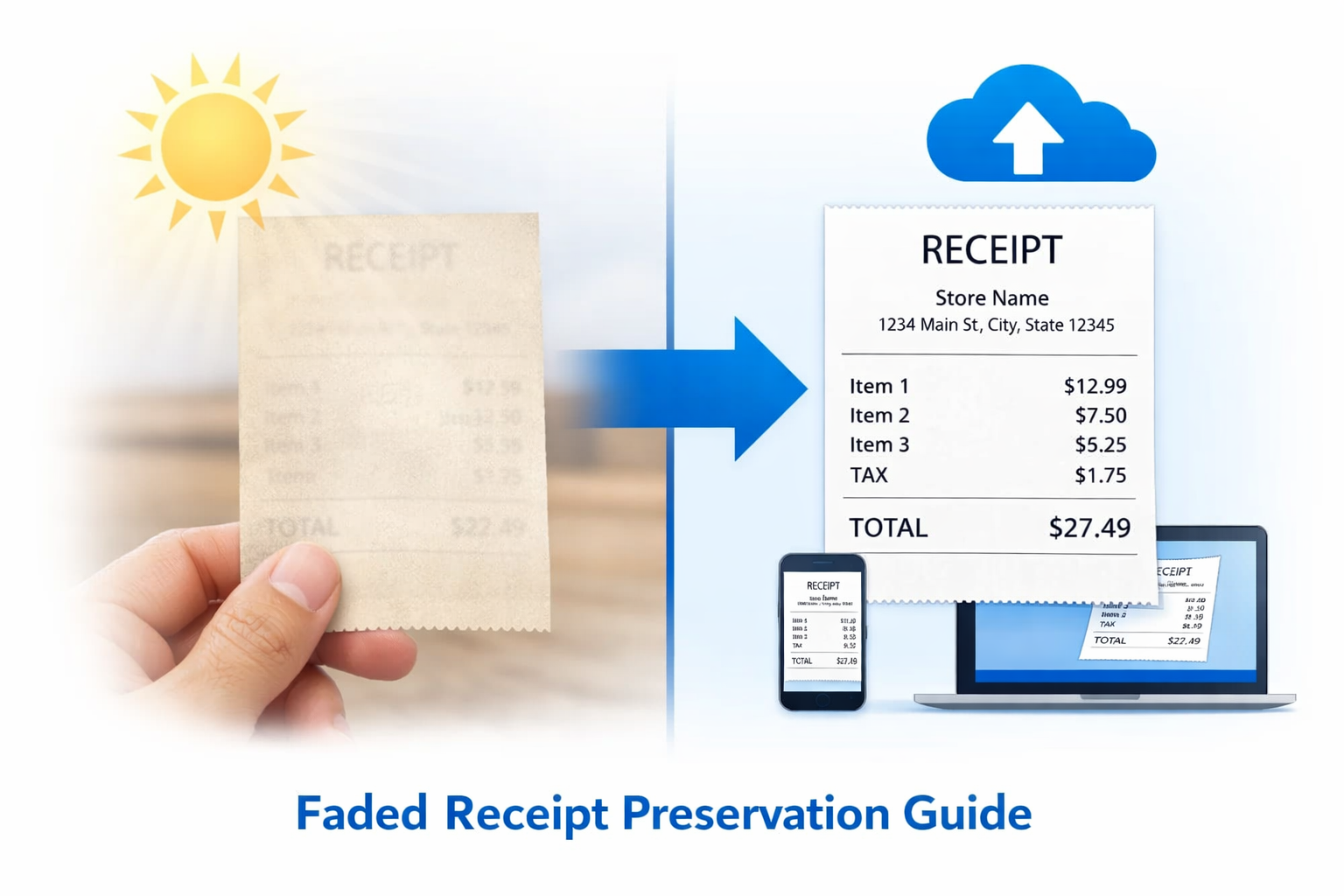
Faded Receipt Preservation Guide
3️⃣ Country-by-Country Rules When Receipt Fades
🇺🇸 United States (IRS)
Requires substantiation; records 3–7 years; digital copies allowed if accurate. If faded: reconstruct via bank record + written explanation; travel expenses stricter.
🇬🇧 United Kingdom (HMRC)
Keep records 6 years; VAT invoices must show VAT number and breakdown; digital acceptable. If faded: VAT claim may be rejected; replacement VAT invoice recommended.
🇮🇳 India (CBIC/GST)
GST ITC requires valid tax invoice (GSTIN, invoice number, tax breakup); 6 years. If faded: ITC reversal possible; GSTR mismatch risk.
🇦🇺 Australia (ATO)
Records 5 years; digital allowed. If faded: deduction may be denied; diary records only in limited travel cases.
🇨🇦 Canada (CRA)
Supporting records required; GST/HST needs valid invoice; electronic storage accepted. If faded: duplicate from vendor recommended; CRA may disallow unsupported claim.
4️⃣ Statistics on Receipt Fading
- Thermal receipts may fade in 12 months if exposed to sunlight
- Heat above 25°C accelerates fading
- 40% of small businesses rely on paper-only storage
- 1 in 3 people store receipts in wallets (high friction + heat)
- Retail environments in tropical countries increase degradation speed
5️⃣ Immediate Action Plan
If your receipt is starting to fade: scan immediately at high resolution, photograph under proper lighting, adjust contrast digitally, request a duplicate invoice, upload to cloud storage, and store the original in a cool, dark place. Speed matters — once text disappears completely, recovery becomes difficult.
6️⃣ Long-Term Preservation Methods
Physical
Store in cool (<20°C), low-humidity, acid-free envelope. Avoid plastic sleeves, direct sunlight, car dashboards, and wallet storage.
Digital
Scan at 300–600 DPI, save as PDF, extract structured data, backup in cloud. Digital copies are superior for audit defense.
7️⃣ Comparison Tables
Paper vs Digital Preservation
| Feature | Paper Receipt | Digitized Copy |
|---|---|---|
| Fading risk | High | None |
| Searchable | No | Yes |
| Audit safe | Weak | Strong |
| Backup | None | Cloud |
| Longevity | 1–2 years | Indefinite |
Storage conditions impact
| Condition | Effect on Receipt |
|---|---|
| Sunlight | Rapid fading |
| Heat | Chemical darkening |
| Humidity | Ink distortion |
| Plastic contact | Chemical reaction |
| Cool dry storage | Extended life |
8️⃣ Prevention Checklist
- Scan immediately after purchase
- Avoid keeping receipts in wallet
- Reconcile monthly
- Use cloud storage
- Enable duplicate detection
- Centralize expense management
- Back up data regularly
9️⃣ How ReceiptRecon Solves Fading Receipt Problems
ReceiptRecon instantly digitizes receipts, extracts structured invoice data, stores an encrypted cloud copy, enables search by vendor/date/amount, prevents duplicate uploads, and creates an audit-ready archive. Even if paper fades, the digital record remains compliant. ReceiptRecon converts unstable thermal paper into permanent structured records.
✅ Final Takeaway
Thermal receipts are temporary by design. Heat, light, and humidity destroy proof of purchase. If receipts fade you risk lost tax deductions, GST/VAT reversal, audit exposure, and warranty denial. Digitization is the permanent solution.
ReceiptRecon ensures instant digital preservation, structured searchable archive, audit-ready compliance, and zero fading risk.
Related Resources
Disclaimer: This content is for informational purposes only. Consult a qualified professional for tax or compliance advice.
🎯 Stop Faded Receipts From Killing Your Deductions
ReceiptRecon digitizes every receipt the moment you capture it — so heat and light never erase your proof of purchase.